LIC Paid-Up Value Calculator & Full Guide (2026)
Instant LIC Paid-Up Value Calculator
Find your reduced Sum Assured and frozen vested maturity value before talking to your LIC agent.
Guide Quick Index
10 Sections1Struggling with LIC Premiums? Don't Surrender Just Yet2What Exactly is 'LIC Paid-Up Value'?3Paid-Up Sum Assured Calculation Formula4Step-by-Step Calculation: Real-World Scenario5LIC Paid-Up Value vs. Surrender Value: Which is Smarter?6Can a Paid-Up Policy be Revived? Rules & Conditions7How Outstanding Loans Impact Paid-Up Value8Tax Treatment of Paid-Up Payouts under Income Tax Act 202595 Costly Mistakes Policyholders Make with Paid-Up Policies10The Verdict: How to Optimize Your LIC Portfolio
Struggling with LIC Premiums? Don't Surrender Just Yet
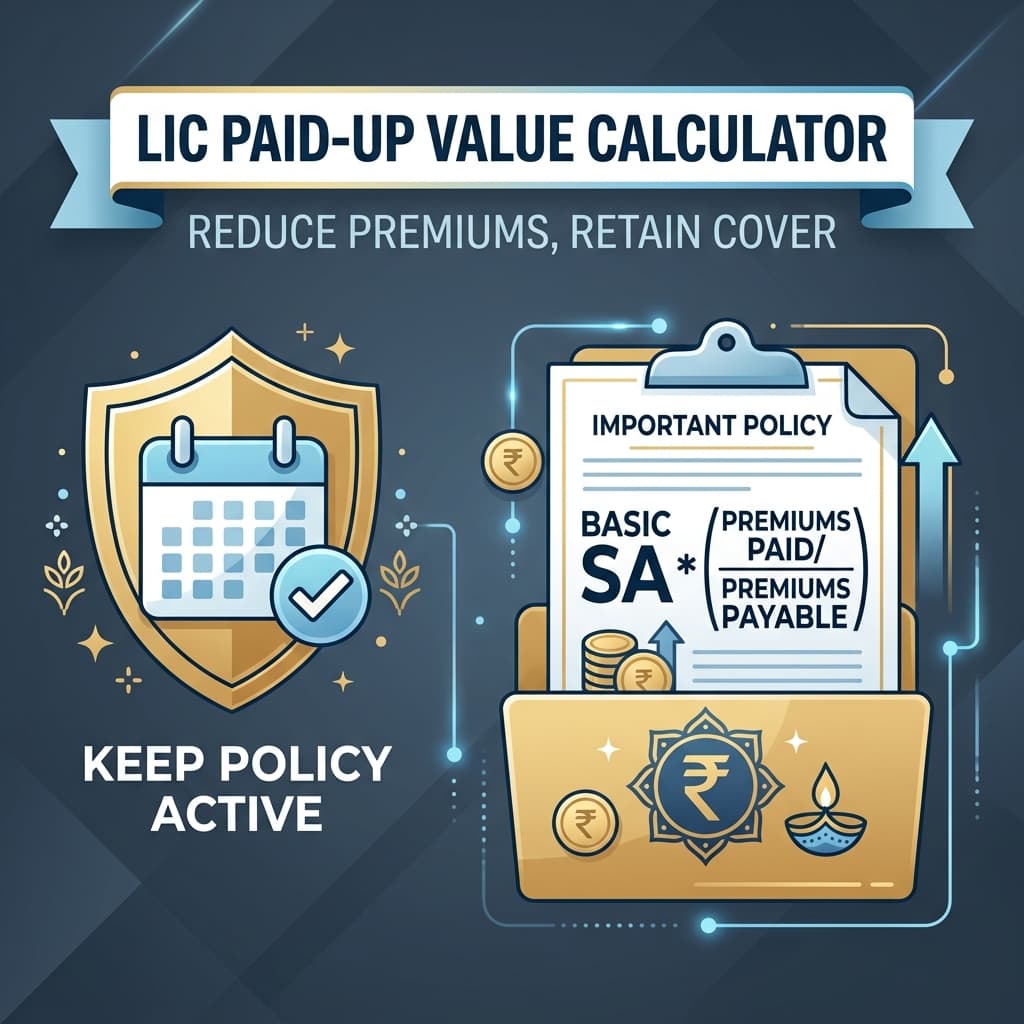
Every year, lakhs of Indian policyholders face a common dilemma: they bought an LIC endowment or money-back policy (like New Jeevan Anand or Jeevan Labh) but now find the premium payments a heavy burden. Life priorities change—maybe there is a home loan EMI, a child's college admission, or a job transition.
When you cannot afford to pay premiums, most agents will tell you to either let the policy lapse or surrender it. But both options are highly destructive. Lapsing the policy strips away your family's life cover completely, while surrendering early locks in an immediate, painful loss of up to 50% to 70% of your total paid premiums.
Fortunately, there is a third, mathematically superior option: converting your policy to 'Paid-Up' status. By making your policy Paid-Up, you stop paying all future premiums entirely, yet your policy remains active, your family's life cover continues (at a reduced rate), and you receive your accrued money at the original maturity date.
In this guide, I will show you exactly how the LIC Paid-Up Value is calculated, compare it against surrendering, break down the revival rules, and explain the tax impact under the Income Tax Act 2025.
What Exactly is 'LIC Paid-Up Value'?
A policy achieves 'Paid-Up' status when the policyholder stops paying premiums after the policy has acquired a vested cash value (typically after paying full premiums for at least 2 or 3 consecutive years).
Instead of terminating the contract, LIC reduces the original Sum Assured proportionately based on the number of premiums actually paid versus the total premiums that were due. This reduced cover is called the Paid-Up Sum Assured or Reduced Sum Assured.
Key Features of a Paid-Up Policy:
1. Reduced Life Cover: Your life cover does not go to zero. If your original cover was ₹10 Lakh and you paid half the premiums, your family remains covered for ₹5 Lakh until maturity.
2. Bonus Freeze: Once a policy becomes paid-up, it stops participating in future annual bonus declarations. However, any bonuses declared and vested before the policy became paid-up are fully protected and will be paid out upon maturity.
3. No Premium Obligations: You do not owe LIC another rupee. Your policy is self-sustaining.
4. Payout Timing: The maturity value is paid out only at the end of the original policy term, or to your nominee in the event of your death.
2. Bonus Freeze: Once a policy becomes paid-up, it stops participating in future annual bonus declarations. However, any bonuses declared and vested before the policy became paid-up are fully protected and will be paid out upon maturity.
3. No Premium Obligations: You do not owe LIC another rupee. Your policy is self-sustaining.
4. Payout Timing: The maturity value is paid out only at the end of the original policy term, or to your nominee in the event of your death.
Paid-Up Sum Assured Calculation Formula
Calculating your policy's paid-up value is simple and transparent. The standard actuarial formula used by LIC is:
$$\text{Paid-Up Sum Assured} = \text{Original Sum Assured} \times \left( \frac{\text{Number of Premiums Paid}}{\text{Total Number of Premiums Payable}} \right)$$
To find your final maturity payout, you add the vested bonuses accumulated before the premium payments stopped:
$$\text{Total Paid-Up Value} = \text{Paid-Up Sum Assured} + \text{Vested Bonuses}$$
Step-by-Step Calculation: Real-World Scenario
Let us look at a concrete example to see how this plays out in real life. Imagine Sunita, a 35-year-old manager in Bengaluru, who bought an LIC New Endowment Plan (Plan 914) with these parameters:
- Original Sum Assured: ₹10,00,000 (10 Lakhs)
- Policy Term (PPT): 20 Years
- Annual Premium: ~₹48,000
- Premiums Paid: 8 Years (Paid ₹3,84,000 in total)
- Vested Bonus: ₹3,20,000 (declared during the first 8 years)
In the 9th year, Sunita decides she cannot continue the policy and wants to make it Paid-Up. Here is the math:
Step 1: Calculate the Paid-Up Sum Assured
Paid-Up SA = ₹10,00,000 × (8 Paid ÷ 20 Payable) = ₹4,00,000
Step 2: Add Vested Bonuses
Vested Bonus = ₹3,20,000 (This remains frozen inside the policy account and does not grow further).
Step 3: Total Maturity Value
Maturity Payout = Paid-Up SA (₹4,00,000) + Vested Bonus (₹3,20,000) = ₹7,20,000
At age 55 (the original maturity year), Sunita receives a guaranteed check of **₹7,20,000** from LIC, despite having paid only ₹3,84,000 in premiums. Furthermore, during those 12 unpaid years, if anything had happened to her, her nominee would have received ₹7,20,000 immediately.
LIC Paid-Up Value vs. Surrender Value: Which is Smarter?
When you want to stop premiums, you must decide whether to make the policy Paid-Up or surrender it. Use our interactive LIC Surrender Value Calculator to find your exact early-exit cash payout, or see this head-to-head comparison to help you choose:
| Feature | Paid-Up Policy | Surrender Value |
|---|---|---|
| Status of Policy | Policy remains active at a reduced level. | Policy terminates completely and instantly. |
| Life Insurance Cover | Continues at the reduced Paid-Up SA level. | Stops completely. Family has no protection. |
| Payout Timing | Paid only at maturity or upon death. | Paid immediately as a cash lump sum. |
| Bonuses Paid | Vested bonuses are fully preserved and paid. | Bonus component is slashed by a surrender factor. |
| Financial Recovery | High. You recover the full proportionate value. | Low. You typically lose 30% to 60% of premiums paid. |
The Verdict: Surrendering only makes sense if you are in a desperate, immediate liquidity crisis. If you can afford to wait until the original maturity date, making the policy Paid-Up preserves far more of your capital.
Can a Paid-Up Policy be Revived? Rules & Conditions
Yes! One of the greatest benefits of converting a policy to Paid-Up (rather than surrendering it) is that **you can revive it later if your financial situation improves**.
- The 5-Year Window: Under LIC's standard terms, you can revive a lapsed or paid-up policy within 5 years from the date of the First Unpaid Premium (FUP).
- Payment of Arrears: You must pay all unpaid premiums from the FUP date up to the revival date, along with compound interest (typically 9% to 9.5% per annum).
- Proof of Continued Insurability: Depending on the policy term and Sum Assured, LIC may require a self-declaration of good health (Form 300/680) or a fresh medical examination to ensure you do not carry new high-risk conditions.
- Reinstatement of Original Cover: Once revived, your original Sum Assured is restored, and you begin earning the full annual reversionary bonuses again.
Before starting the revival process, you should verify the exact date of your first unpaid premium. Read our comprehensive guide on LIC policy status online check to find out how to trace your policy's FUP date using WhatsApp, SMS, or the web portal.
How Outstanding Loans Impact Paid-Up Value
If you have taken a loan against your LIC policy, making it Paid-Up requires careful calculation. LIC charges interest on policy loans. When a policy is active, you pay this interest annually or let it accumulate.
However, when you stop paying premiums and convert to Paid-Up, the policy's cash value stops growing aggressively. If the accumulated loan principal plus interest exceeds the surrender value of the paid-up policy, **LIC reserves the right to forcefully foreclose your policy** to recover its dues, leaving you with no life cover and no maturity payout.
My Expert Advice: If you plan to make a policy Paid-Up, always clear any outstanding loans first (you can estimate your loan details using our LIC Loan Calculator), or ensure the paid-up value is significantly higher than the debt to prevent foreclosure.
Tax Treatment of Paid-Up Payouts under Income Tax Act 2025
The tax treatment of a paid-up policy's maturity payout is governed by the reorganized codes of the **Income Tax Act 2025**:
- Maturity proceeds taxability (Schedule II): If the aggregate annual premium of all your traditional policies (including the one you made paid-up) remains under ₹5,00,000, the final maturity payout (Paid-Up SA + Vested Bonus) is 100% tax-free.
- High-Premium Policies: If your aggregate annual premium exceeds ₹5,00,000, the net profit (maturity payout minus total premiums paid) is fully taxable as 'Income from Other Sources' at your marginal slab rate.
- Section 80C Clawback: Unlike surrendering early, making a policy paid-up does not trigger a reversal of past tax deductions claimed under Section 80C (now Section 123), provided you paid premiums for at least 2 full years.
- TDS Applicability: If the maturity payout is taxable, a 5% TDS is deducted from the net profit portion at the time of payout.
5 Costly Mistakes Policyholders Make with Paid-Up Policies
- Lapsing instead of making Paid-Up: If you stop paying premiums in the first or second year before acquiring a surrender value, the policy lapses completely. You get zero return and lose your cover. Always ensure you complete at least 2 full years of premiums.
- Surrendering out of panic: Surrendering is an irreversible action that destroys capital. Always check if making the policy Paid-Up is a viable option for your timeline.
- Ignoring the 5-year revival deadline: Many policyholders forget about their paid-up policy and let the 5-year window slide, losing the chance to ever reinstate their original cover.
- Neglecting to track policy loan interest: Letting loan interest compound on a paid-up policy is a recipe for forced foreclosure. Keep track of your loan balances.
- Not updating nominee details: Since paid-up payouts are received years down the line, ensure your nominee details remain active and updated with LIC.
The Verdict: How to Optimize Your LIC Portfolio
If you are struggling to pay premiums, converting your policy to Paid-Up is a highly effective way to halt expenses while preserving your capital and family cover. But don't make the decision blindly.
My Recommendation: Use our free, interactive Paid-Up Value Calculator below to see exactly what your policy will pay at maturity. Compare those numbers with your surrender value to make the smartest financial decision.
Calculate Your Exact LIC Paid-Up Value in Seconds
Enter your policy details to see your reduced sum assured, vested bonuses, and final maturity payout today!
Frequently Asked Questions: LIC Paid-Up Value
Free CFP Actuarial Payout Summary
Want a Detailed Policy Payout Summary on WhatsApp?
Get an actuarially verified breakdown of guaranteed bonuses, tax savings under Section 10(10D), and year-by-year cashflow tables.
100% Free Consultation WhatsApp Direct Delivery Zero Sales Spam
Related Tools in This Category
అధికంగా అనిపిస్తుందా? నేను సహాయం చేయనివ్వండి.
ఇప్పటికీ ఏ ఫండ్లను ఎంచుకోవాలో ఖచ్చితంగా తెలియదా? ఇది పూర్తిగా సాధారణం. మరింత వ్యక్తిగతీకరించిన విధానం కోసం, నేను మీ నిర్దిష్ట లక్ష్యాలు మరియు రిస్క్ ప్రొఫైల్ ఆధారంగా ఫండ్ల క్యూరేటెడ్ జాబితాను పొందడంలో మీకు సహాయపడగలను.
నా వ్యక్తిగతీకరించిన ఫండ్ జాబితాను పొందండి